In high school, I was a devoted member of my school’s Science Club. We met one a week for about an hour during which time we would do fun experiments, like making polymer bouncy balls and bending glass. Twice a year, we would tie dye shirts. When you have a well-stocked chemistry lab closet, you can make some pretty amazing shirts that seemingly never fade. I have one from my sophomore (or maybe junior?) year that’s still vibrant.
Several years ago, when my elder daughter was born, I decided to see if I could replicate my earlier results with some cotton onesies. Although I lacked Dr. Moeller’s stash of urea, the combination of soda ash and water I mixed up instead did an excellent job fixing the dye. It turns out that my daughters love tie dye and, as they have gotten older, they’ve learned to make their own. They also love making shirts to give as gifts to their friends.
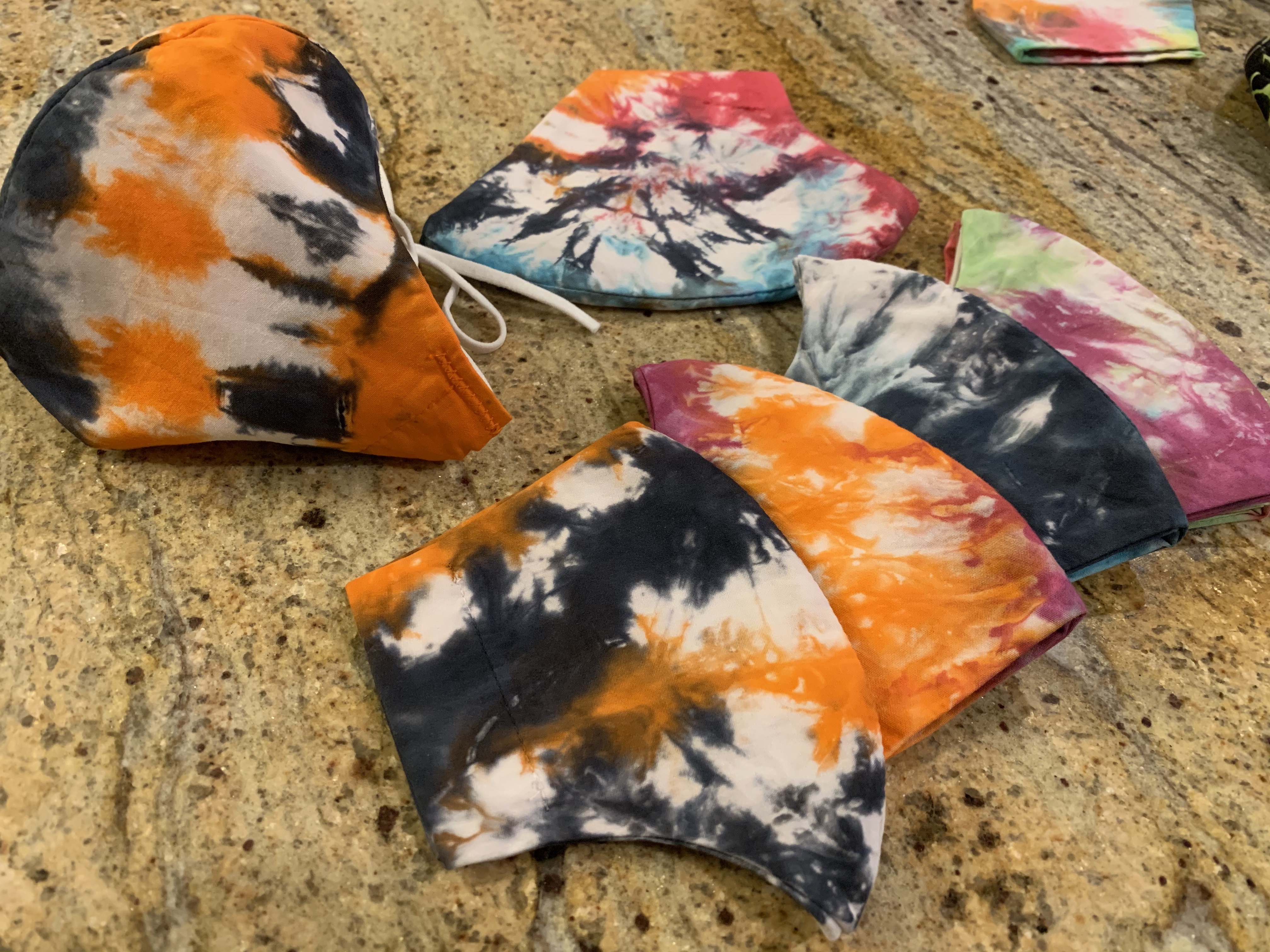
In addition to the big batch of face masks the girls have recently sewed, we did a couple of shirts (and some onesies for friends having babies) this past weekend. As we were going through the various steps, I started thinking about how much I enjoy the process. It’s ritualistic nature appeals to me.
My favorite part, however, has always been what I call The Reveal. It’s that moment near the end where you take the rubber bands off of the dyed shirts and then unfurl them and rinse out the excess dye before the final step of laundering and drying them. The Reveal is when you find out if the idea you had in your head for how the item would look matches the reality of what you have produced.
Over the years, I’ve definitely had some pieces that turned out better than others. But, as Bob Ross might say, even the ones that didn’t look as I’d expected have been happy accidents.
As I was unwrapping the items we dyed this weekend, I thought about the ways in which this process reflects my own journey. I’m not sure how all of this [gestures vaguely] is going to turn out. My vision for the future isn’t particularly clear and I’m afraid of it turning out muddy. But, if there’s a lesson to be gained from tie dying, maybe it is this: However it turns out, I will find something about it to appreciate.
From history major, with side quests in Medieval Studies and chemical engineering, to nonprofit finance leader, Big 4 tax partner, technologist, researcher, and now co-founder of Divine, nothing about my career has been linear. The throughline has always been systems: financial systems, organizational systems, technological systems, and human systems. I have an MBA in Operations and Supply Chain Management and a PhD in Organizational Leadership Psychology, and I’ve spent my career trying to understand how complex systems shape people’s choices, opportunities, wellbeing, and sense of belonging. Today, my work sits at the intersection of psychology, technology, human-centered design, and digital trust. I am co-founder of Divine, an open-source, decentralized social video app built to put creativity back in human hands and replace doomscrolling with joyscrolling. Divine is part of a bigger question I care deeply about: how do we create online spaces that support safety, creativity, identity, and belonging without defaulting to surveillance, extraction, or control? At Divine, I wear a lot of hats across engineering, finance, operations, and strategy, while helping shape the app’s trust, safety, and values work. I focus especially on teen online safety, human-generated content, participatory design, and healthier relationships with technology. I am a postdoctoral alum of Vanderbilt University’s Department of Computer Science, where I worked with Dr. Pam Wisniewski’s Socio-Technical Interaction Research Lab. I continue to write, speak, and research at the intersection of online safety, digital trust, decentralized technology, and youth wellbeing. I was named a Distinguished Fellow at the Institute for Data Integrity in 2023. In 2025, I had the honor of serving as President of Division 13 of the American Psychological Association, the Society of Consulting Psychology. I also live with major depressive disorder and obsessive-compulsive disorder. In 2020, I took a leave from PwC to focus on my mental wellness, and I now speak and write openly about mental health, especially in the workplace and in relation to digital wellbeing. This blog, Seriously Jerk Brain, chronicles much of that journey.
View all posts by liz