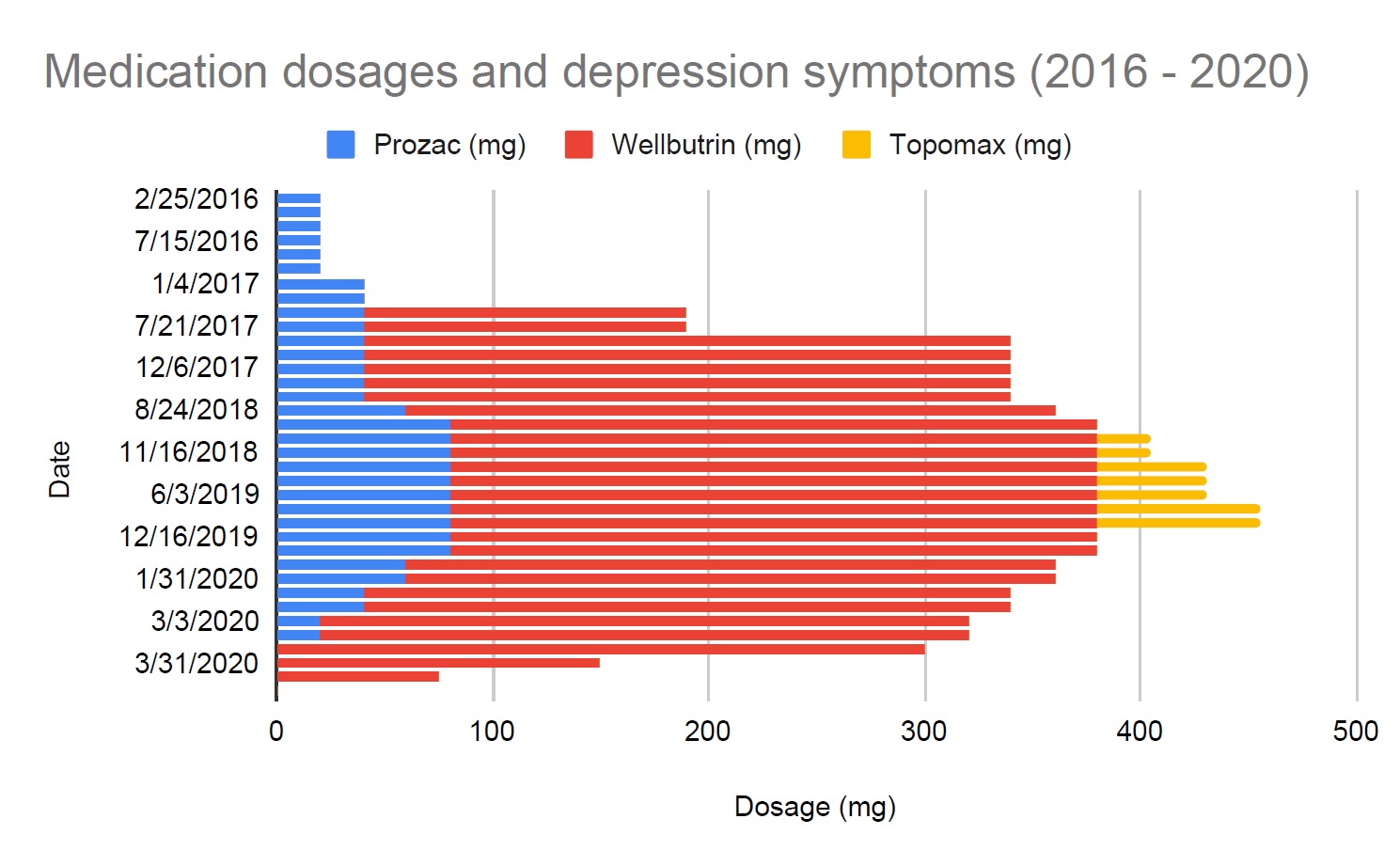
The featured image on this post is a stacked-bar chart I made showing the dates of my psychiatrist appointments and the changes in my medications and dosages since late February 2016, when I resumed psychiatric treatment after nearly a decade. The last line of the chart shows yesterday’s date, when my psychiatrist and I concluded that I can stop taking my last drug, Wellbutrin, and see what my life is like unmediated for the first time in 1,525 days. I’m happy about this development because it was something I wanted to work toward, having been on so much medication for so long that I had no sense of my true mental state. The literature on prolonged high doses of mental health medications is spotty at best and what studies have been done show that, over time, the medication often loses its efficacy and may even cause regression in patients. I want to be clear that psychiatric medication is not inherently bad and taking it is not an indictment of someone’s strength of character or worth as a human being. Medication is one of many tools that doctors can use to help their patients navigate an insidious illness.
There are two next steps on the horizon, one I’m excited about and the other not so much. First, I get to relax a bit and reacquaint myself with my brain, my mind, and my emotional state as it is now. I’m looking forward to watching a movie and tearing up, as opposed to looking around to determine how everyone else is reacting so I can project the appropriate emotional response. It’s very strange to admit, but I miss crying. I haven’t cried in, literally, years. I’m also looking forward to laughing until I cry. I cannot remember the last time that happened.
What I’m not excited about is tackling the portion of my recovery that is not medication related, but rather a question of the environmental and personal stressors that triggered the severe depression from which I am emerging. The good news is that I do not have to do that part alone. The next stage of my recovery involves working through it with my therapist.
From history major, with side quests in Medieval Studies and chemical engineering, to nonprofit finance leader, Big 4 tax partner, technologist, researcher, and now co-founder of Divine, nothing about my career has been linear. The throughline has always been systems: financial systems, organizational systems, technological systems, and human systems. I have an MBA in Operations and Supply Chain Management and a PhD in Organizational Leadership Psychology, and I’ve spent my career trying to understand how complex systems shape people’s choices, opportunities, wellbeing, and sense of belonging. Today, my work sits at the intersection of psychology, technology, human-centered design, and digital trust. I am co-founder of Divine, an open-source, decentralized social video app built to put creativity back in human hands and replace doomscrolling with joyscrolling. Divine is part of a bigger question I care deeply about: how do we create online spaces that support safety, creativity, identity, and belonging without defaulting to surveillance, extraction, or control? At Divine, I wear a lot of hats across engineering, finance, operations, and strategy, while helping shape the app’s trust, safety, and values work. I focus especially on teen online safety, human-generated content, participatory design, and healthier relationships with technology. I am a postdoctoral alum of Vanderbilt University’s Department of Computer Science, where I worked with Dr. Pam Wisniewski’s Socio-Technical Interaction Research Lab. I continue to write, speak, and research at the intersection of online safety, digital trust, decentralized technology, and youth wellbeing. I was named a Distinguished Fellow at the Institute for Data Integrity in 2023. In 2025, I had the honor of serving as President of Division 13 of the American Psychological Association, the Society of Consulting Psychology. I also live with major depressive disorder and obsessive-compulsive disorder. In 2020, I took a leave from PwC to focus on my mental wellness, and I now speak and write openly about mental health, especially in the workplace and in relation to digital wellbeing. This blog, Seriously Jerk Brain, chronicles much of that journey.
View all posts by liz