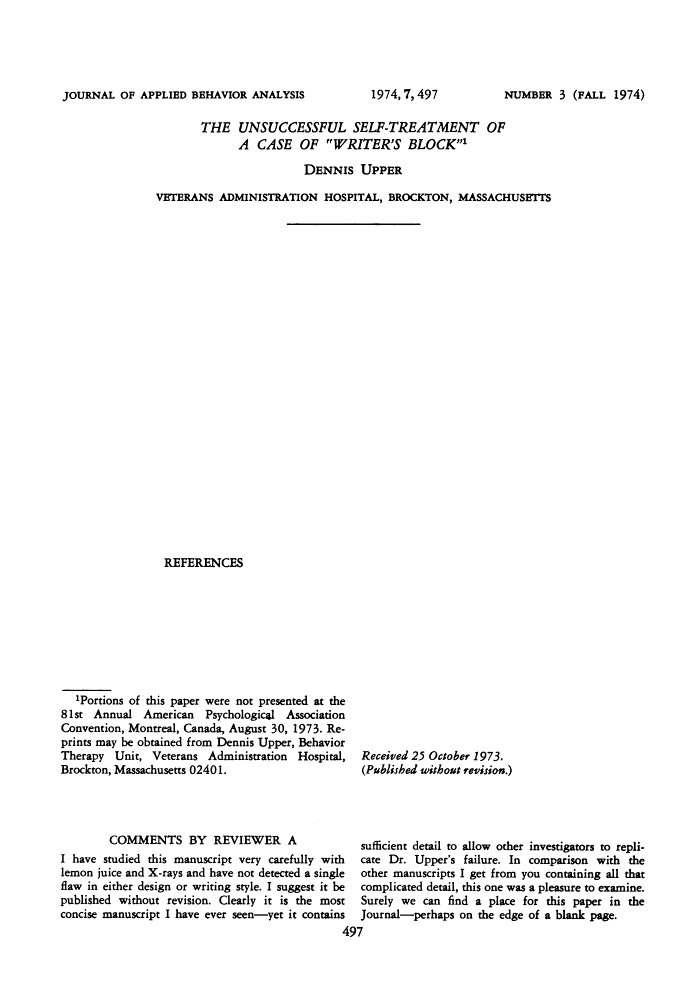
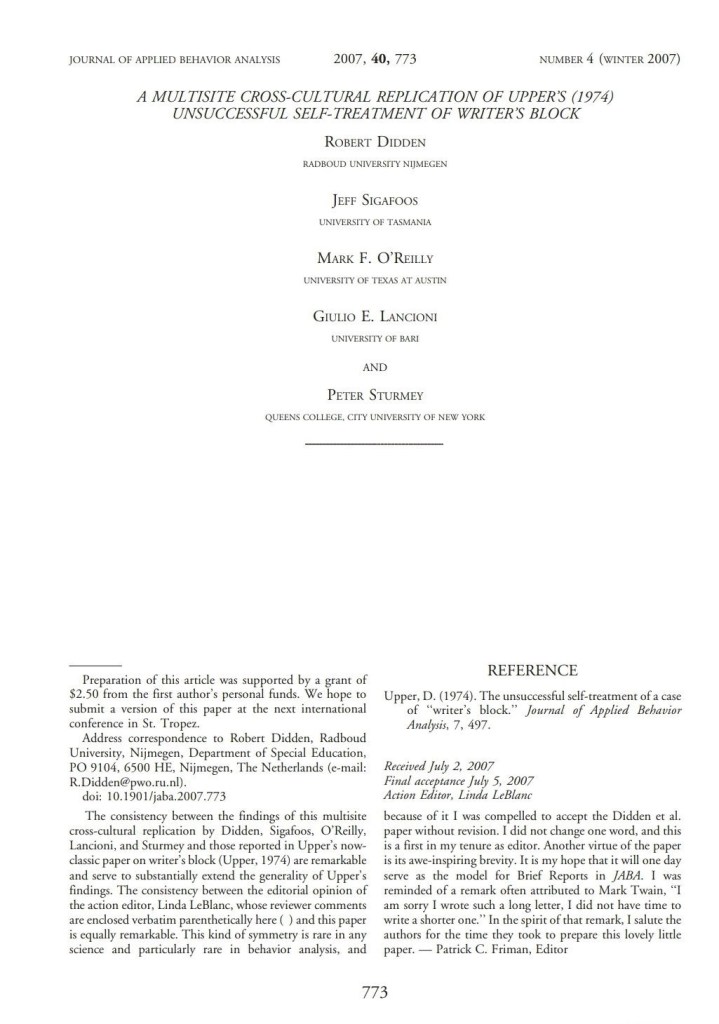
Last week, having fallen headfirst down the Google Scholar rabbit hole, I found a pair of funny articles on the subject of writer’s block. Those familiar with academic writing will likely find the most amusement from them, but they’re pretty audience agnostic.
Perusing these pieces of satire, I started thinking about my own writing process. I have always written, but until recently would not have described myself as a writer. I’m not sure why I felt this way. Every job I’ve ever had has entailed significant amounts of writing and I’ve published articles on everything from musiccriticism to technical finance topics.
Since taking a creative writing class in college that focused on memoir, I’ve been hooked on that style. Blogging is memoir in that it’s an autobiographical first-person account of a part of my life. I’m comfortable writing this way, conversationally and candidly. It’s from that last part, the bit about being candid, that I’ve discovered where my own writer’s block originates.
The times I find myself staring at a blank screen or page, willing words to find their way onto it, it’s not because I don’t have something to say. It’s because I’m unwilling to say it. My writer’s block is a function of my holding back from saying what I’m really thinking or feeling. Everything is there, in my mind, but my Jerk Brain is nixing it before I can get it down.
What will people think if you write that?
None of your words matter.
No one cares what you have to say.
Your writing is banal and derivative.
Writing is cathartic for me because it involves tackling Jerk Brain. That’s why, especially on days where I’m convinced I have nothing of value to say, I sit down and write anyway. It’s another act of defiance against the voice that tells me I’m a failure. Usually, the days I’m convinced I have the least to say are the ones where I experience the greatest breakthroughs in my writing. Those are the days where I am forced to be rigorously honest with myself about why I am suppressing my thoughts and feelings. When I overcome that reticence and write from that place deep inside where my truth lives, that is when I grow.
From history major, with side quests in Medieval Studies and chemical engineering, to nonprofit finance leader, Big 4 tax partner, technologist, researcher, and now co-founder of Divine, nothing about my career has been linear. The throughline has always been systems: financial systems, organizational systems, technological systems, and human systems. I have an MBA in Operations and Supply Chain Management and a PhD in Organizational Leadership Psychology, and I’ve spent my career trying to understand how complex systems shape people’s choices, opportunities, wellbeing, and sense of belonging. Today, my work sits at the intersection of psychology, technology, human-centered design, and digital trust. I am co-founder of Divine, an open-source, decentralized social video app built to put creativity back in human hands and replace doomscrolling with joyscrolling. Divine is part of a bigger question I care deeply about: how do we create online spaces that support safety, creativity, identity, and belonging without defaulting to surveillance, extraction, or control? At Divine, I wear a lot of hats across engineering, finance, operations, and strategy, while helping shape the app’s trust, safety, and values work. I focus especially on teen online safety, human-generated content, participatory design, and healthier relationships with technology. I am a postdoctoral alum of Vanderbilt University’s Department of Computer Science, where I worked with Dr. Pam Wisniewski’s Socio-Technical Interaction Research Lab. I continue to write, speak, and research at the intersection of online safety, digital trust, decentralized technology, and youth wellbeing. I was named a Distinguished Fellow at the Institute for Data Integrity in 2023. In 2025, I had the honor of serving as President of Division 13 of the American Psychological Association, the Society of Consulting Psychology. I also live with major depressive disorder and obsessive-compulsive disorder. In 2020, I took a leave from PwC to focus on my mental wellness, and I now speak and write openly about mental health, especially in the workplace and in relation to digital wellbeing. This blog, Seriously Jerk Brain, chronicles much of that journey.
View all posts by liz


 Seriously, Jerk Brain?!